

Unlocking Potential: Integrating Primitive Reflexes to Support Motor and Cognitive Development in Children with Down Syndrome
- Aug 1, 2025
- 5 min read
Updated: Aug 1, 2025

How to Talk to Other Parents (aka TL;DR)
Primitive reflexes are automatic baby movements that usually disappear as the brain matures. When they don’t integrate properly, they can affect motor and cognitive skills. Many kids with Down syndrome show these retained reflexes, which can make balance, coordination, and attention harder. Therapies using gentle movements and sensory experiences to “turn off” these old reflexes and may be able to help kids move and learn better. Encouraging tummy time, crawling, and working with therapists can support this process. It’s about helping the brain grow pathways that support your child’s unique strengths.
As a neuroscientist, I am constantly humbled by the intricate web of brain development that shapes each child’s unique abilities and challenges. I also am rather skeptical by nature. When I posted about the ATNR, the “algorithms that be” started showing me reel after reel about therapeutic interventions to integrate primitive reflexes, I had to investigate further. When it comes to Down syndrome (DS), understanding how early developmental building blocks, especially primitive reflexes, impact later motor and cognitive skills is crucial. In this post, we’ll look at the neuroscience behind primitive reflexes, their retention, and how targeted therapies show promise towards fostering integration and empowerment for your child.
What Are Primitive Reflexes and Why Do They Matter?
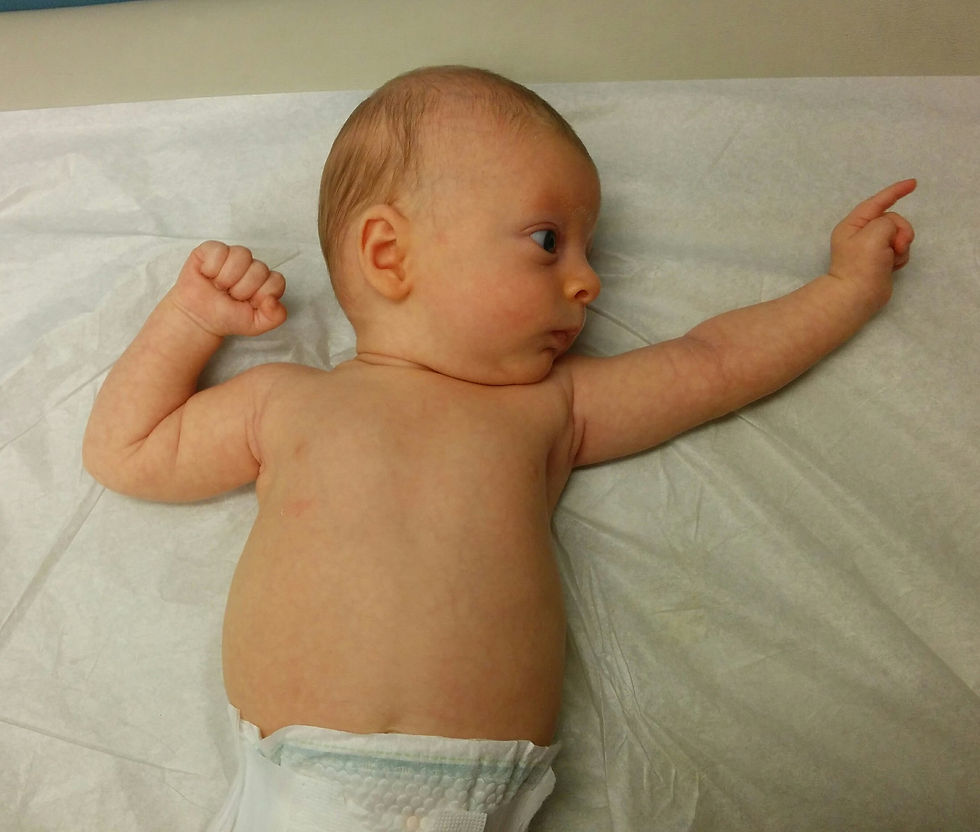
Primitive reflexes are automatic, brainstem-controlled movements essential for survival in infancy. These include the Moro (startle) reflex, the rooting reflex (helping infants find food), and the asymmetric tonic neck reflex (ATNR), among others aptly described by Samantha Heidenreich, OTD, MOT here. (The entire article is recommended as a reasonable assessment of and practical guide to primitive reflex integration.) Typically, these reflexes integrate, meaning they are inhibited as the brain matures and is able to support voluntary, controlled movements (Heidenreich, 2021).
However, when these reflexes persist beyond infancy, a condition called retained primitive reflexes (RPRs), they can interfere with sensorimotor development, coordination, balance, and even cognitive functions such as attention and learning (Heidenreich, 2021; Bob et al., 2021). In children with DS, studies have shown that reflex patterns are often immature or dysfunctional, with more than 80% demonstrating significant retention (Masgutova et al., 2016).
Why Is This Important for Children with Down Syndrome?
DS is a complex neurogenetic condition caused by an extra copy of chromosome 21, affecting brain structure and function. Key brain areas like the frontal lobe, temporal lobe, and cerebellum, critical for motor planning, memory, language, and balance, are disproportionately smaller and show altered connectivity (Gardiner et al., 2010). Muscle hypotonia (low tone) common in DS also affects motor control, although fundamental reflex arcs may remain intact.
Because RPRs are linked to poor hand-eye coordination, balance issues, sensory sensitivities, and difficulties crossing the midline, their persistence can compound the challenges posed by DS’s underlying brain differences (Heidenreich, 2021). For example, the retained ATNR can lead to handwriting and gait difficulties, while the Moro reflex’s retention may contribute to sensory hypersensitivity and poor stamina.
How Do Primitive Reflexes Connect to Brain Development?
Early motor activity profoundly shapes brain maturation. The vestibular system, responsible for sensing gravity and movement, is fully mature at birth and sends continuous input that supports multisensory integration across brain regions (Tele-Heri et al., 2021). Multisensory integration, the brain’s way of combining signals from different senses, is essential for language, spatial awareness, and cognition, areas often impacted in DS (Gardiner et al., 2010). In ADHD, for example, persistent reflexes correlate with specific motor and attention deficits, with some differences noted between boys and girls (Bob et al., 2021). These findings underscore the intricate link between primitive reflexes, neural circuitry, and behavior.
Can We Help Integrate These Reflexes? What Does the Science Say?
Targeted sensorimotor therapies designed to integrate primitive reflexes are showing promising results, especially when initiated early.
The Masgutova Neurosensorimotor Reflex Integration (MNRI®) Program seems to be one of the foremost approaches focused on people with DS. The MNRI employs gentle, structured exercises to activate and reorganize sensory-motor pathways encoded at the genetic level. In children with DS, an 11-day MNRI® therapy course led to significant improvements in reflex profiles and sensory-motor skills, although full normalization takes longer (Masgutova et al., 2016).
Targeted Sensorimotor Therapy (TSMT), developed in Hungary, leverages the vestibular system’s primacy by combining rhythmic, cross-modal sensory experiences. A one-year TSMT intervention improved primitive reflex integration, motor control, body schema perception, and tactile processing in children with ADHD, suggesting similar approaches could support DS as well (Tele-Heri et al., 2021).
While direct experimental literature remains limited, the theoretical grounding and clinical observations emphasize that integrating reflexes restores more mature movement patterns that scaffold learning and development (Heidenreich, 2021). Additionally, multiple sources noted broader sensory integration therapies, rather than these specific programs, typically employed by occupational therapists show similar benefits and gains.
What Can Parents Do at Home?
Encourage tummy time and crawling during infancy and toddler years, as these activities promote reflex integration and motor coordination.
Incorporate simple sensorimotor exercises recommended by therapists aimed at gradually reducing retained reflex influence.
Foster a rich sensory environment, balanced vestibular input (e.g., gentle swinging), tactile exploration, and visual tracking activities.
Collaborate closely with occupational and physical therapists familiar with reflex integration and neurodevelopmental approaches tailored for DS.
Conclusion
Though I personally would love to see neuroimaging studies demonstrating neuroplasticity induced by these interventions, the functional improvements that have been observed and reported will have to do for now. Integrating primitive reflexes represents a dynamic frontier in neurodevelopmental intervention. Through a deeper understanding of brain mechanisms and personalized sensory-motor therapies, we can support children with Down syndrome in unlocking their movement, communication, and learning potential. Certainly an area where we can continue embracing curiosity....
References
Bob, P., Konicarova, J., & Raboch, J. (2021). Disinhibition of primitive reflexes in attention deficit and hyperactivity disorder: Insight into specific mechanisms in girls and boys. Frontiers in Psychiatry, 12, Article 430685. https://doi.org/10.3390/fpsyt.2021.430685
Gardiner, K., Herault, Y., Lott, I. T., Antonarakis, S. E., Reeves, R. H., & Dierssen, M. (2010). Down syndrome: From understanding the neurobiology to therapy. The Journal of Neuroscience, 30(45), 14943–14945. https://doi.org/10.1523/JNEUROSCI.3728-10.2010
Heidenreich, S. (2021). Understanding primitive reflexes: How they impact child development and intervention strategies for integration. OccupationalTherapy.com, Article 5409.
Masgutova, S., Akhmatova, N., & Ludwika, S. (2016). Reflex profile of children with Down Syndrome improvement of neurosensorimotor development using the MNRI® Reflex Integration Program. International Journal of Neurorehabilitation, 3, Article 197. https://doi.org/10.4172/2376-0281.1000197
Tele-Heri, B., Dobos, K., Harsanyi, S., Palinkas, J., Fenyosi, F., Gesztelyi, R., More, C. E., & Zsuga, J. (2021). Vestibular stimulation may drive multisensory processing: Principles for targeted sensorimotor therapy (TSMT). Brain Sciences, 11(8), Article 1111. https://doi.org/10.3390/brainsci11081111
Comments